
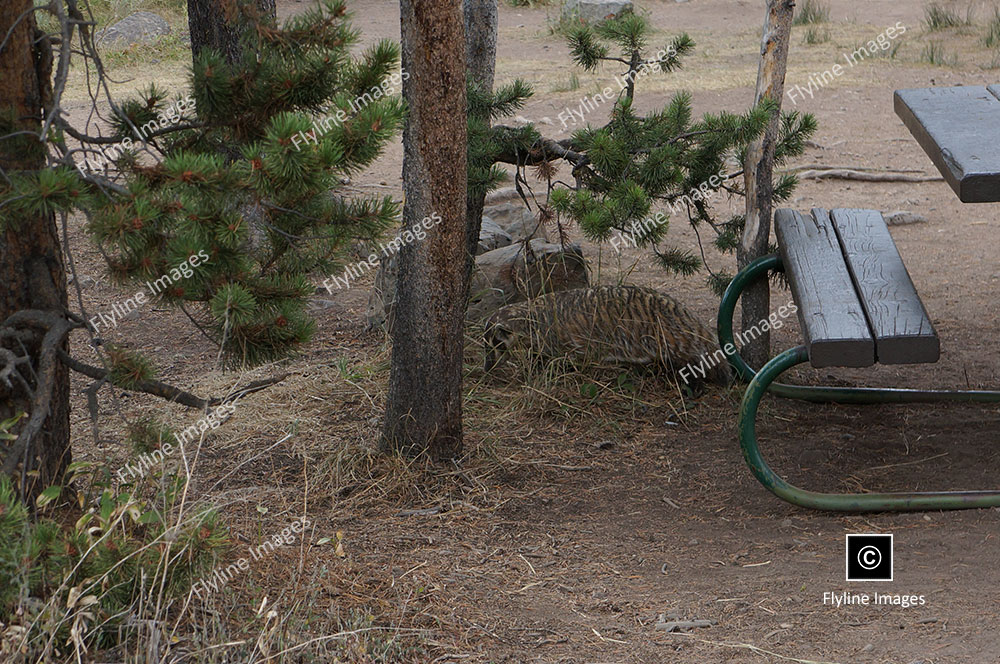
Yellowstone National Park Badger
North American Badger 3
$5.00
Description
Purchase this photo of a Yellowstone National Park Badger. This Badger was photographed near the Gardner River, approximately 5 miles outside of Mammoth Springs.
The North American Badger (Taxidea taxus), a formidable and fascinating member of the weasel family (Mustelidae), is a creature perfectly adapted for a life of digging. Found across the western and central regions of the continent, these solitary carnivores thrive in open landscapes, most notably within the protected expanses of Yellowstone National Park, due to an ideal combination of habitat and abundant prey.
Built for Burrowing: The Badger’s Profile
The American badger is characterized by its stocky, low-slung, and somewhat flattened body, supported by short, powerful legs. Adults typically weigh between 9 and 26 pounds and measure roughly 18 to 22 inches in length, excluding the short tail.
Their physical adaptations make them the only true fossorial (specialized for digging) carnivore in North America. They possess remarkably long, strong front claws—sometimes measuring up to 2 inches—and muscular forelimbs that allow them to excavate soil with astonishing speed. Their heads are conical, and they have loose skin that enables them to maneuver in tight underground spaces. To protect themselves while digging, they have small ear canals and a specialized, transparent third eyelid, called a nictitating membrane, which shields their eyes from dirt.
The badger’s coat is shaggy and grizzled, a mixture of brown, black, and white hairs that provides excellent camouflage in grassy and sandy environments. They are most easily recognized by their distinctive facial markings: a white stripe running from the nose over the top of the head, contrasting sharply with black patches (or “badges”) on their cheeks.
Habitat and Diet: Underground Hunters
Badgers prefer dry, open habitats such as grasslands, prairies, sagebrush steppes, and deserts. The critical requirement for their habitat is friable (easily crumbled) soil that allows for efficient digging, along with a healthy population of burrowing rodents.
Their diet consists primarily of small mammals, including pocket gophers, ground squirrels, prairie dogs, voles, and mice. Badgers hunt by locating prey underground and rapidly digging them out. They are opportunistic, however, and will also consume ground-nesting birds and their eggs, reptiles (including snakes), insects, and carrion.
In a fascinating example of interspecies cooperation, badgers sometimes hunt alongside coyotes. This partnership works because of their differing hunting styles. If a ground squirrel sees a coyote, it retreats into its burrow, where the badger can dig it out. If the squirrel sees the badger first, it may flee above ground, where the faster coyote can catch it. Research suggests this tandem hunting increases the catch rate for coyotes and allows badgers to expend less energy hunting underground.
Behavior and Lifecycle
American badgers are typically solitary and primarily nocturnal, though they can be seen during the day, especially in remote areas or when females are nursing young in the spring.
Their lives revolve around their burrows (dens), which they dig for shelter, sleeping, and raising offspring. A badger maintains multiple dens within its home range and may switch locations frequently—sometimes digging a new burrow almost daily.
In winter, badgers do not hibernate. Instead, they may enter periods of torpor, a state of decreased physiological activity and lowered body temperature, often lasting around 29 hours. They remain in their dens during extreme cold but will emerge on warmer days.
Mating occurs in late summer and early fall. Through a process called delayed implantation, the embryos do not begin to develop until winter. Females give birth to a litter of one to five cubs in early spring (March to May). The young are born helpless and blind, remaining with their mother for several months.
Why Badgers Thrive in Yellowstone National Park
Yellowstone National Park hosts a significant and commonly observed population of North American badgers. The park provides a near-perfect environment for these animals, contributing to their success within its boundaries.
1. Abundant Prey: The primary reason for the high density of badgers in Yellowstone is the plentiful supply of food. The park’s expansive valleys and sagebrush flats, such as the Lamar Valley and the area known as Little America, are teeming with Uinta ground squirrels—a favorite prey item for badgers. The presence of healthy populations of pocket gophers and other rodents ensures a consistent food source.
2. Ideal Habitat: Yellowstone offers vast stretches of the open, treeless terrain that badgers prefer. The sagebrush flats and grasslands provide the necessary soil conditions for digging extensive burrow systems and hunting tunnels.
3. A Protected Ecosystem: Yellowstone is home to the largest concentration of mammals in the lower 48 states. As a protected national park, it maintains natural ecological processes and predator-prey dynamics. Unlike agricultural areas where rodent control programs can eliminate their food source, or where habitat fragmentation threatens their survival, Yellowstone offers a vast, contiguous sanctuary where badgers can maintain large home ranges and thrive with minimal human disturbance.
Image & Download Information
For this product, we have provided 3 image size options, Large 4000 x 2500, Medium 2000 x 1250 and Small 1000 x 625. When you purchase this photo, you will receive an email confirmation of your order. That email will summarize your purchase and provide you with the download links for the images and videos you purchased.
Additional information
| Purchase Image | Purchase Image For Your Use |
|---|