
While you might expect the Gray Wolf to be the default, Yellowstone’s wolf population is actually split almost 50/50 between gray and black wolves.
Wolf 10039 P
$15.00
Description
Creative by Flyline Images
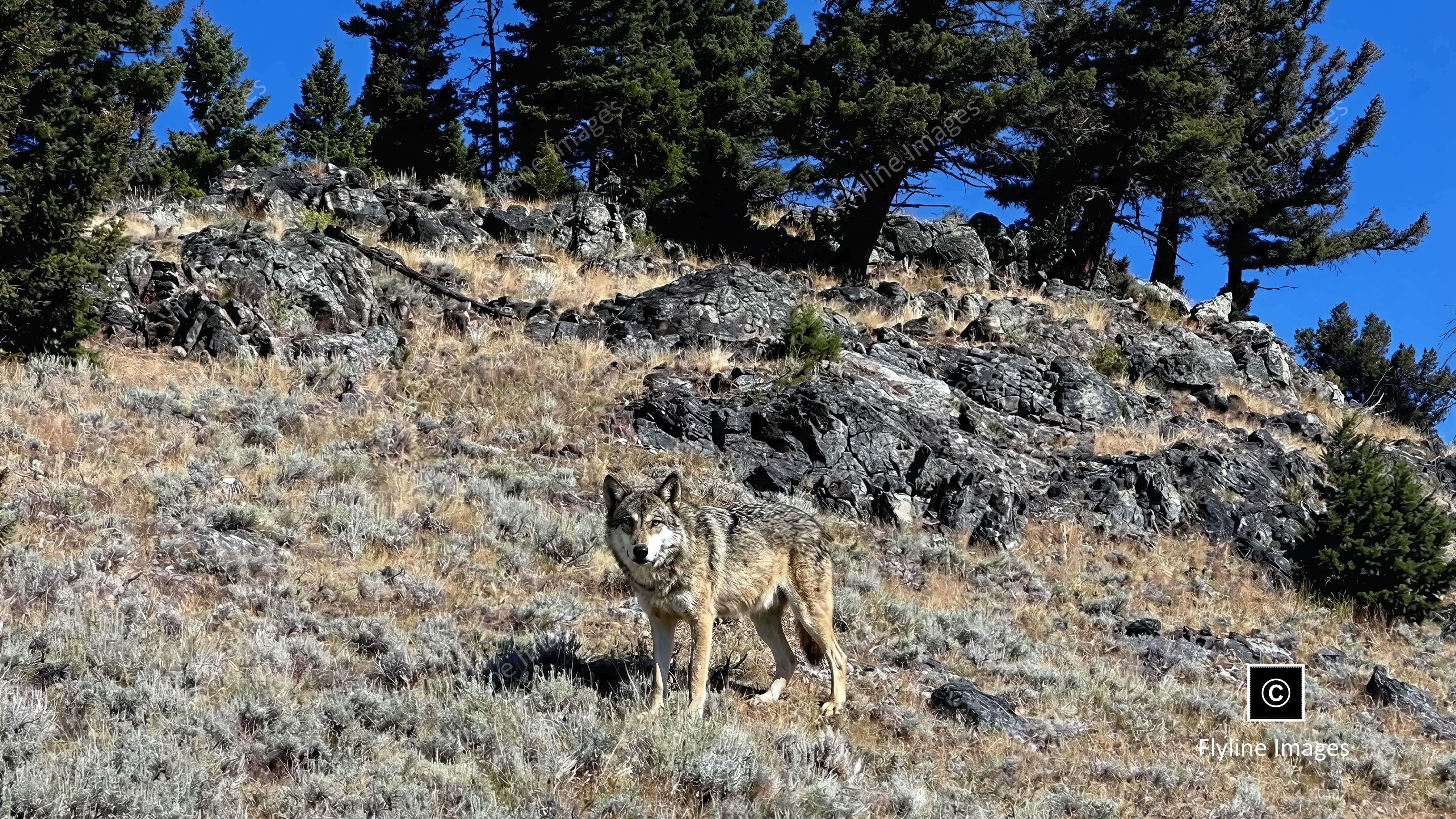
You are looking at a Gray Wolf. The wolf is in an area near the Slough Creek Trail, in Yellowstone National Park.
Here is the breakdown of why the gray coat is the superior camouflage in Yellowstone, and the fascinating reason why the non-camouflaged black wolves survive anyway.
1. The Camouflage Kings: Gray Wolves
In the specific terrain of Yellowstone—which is largely high-desert sagebrush, rocky ridges, and open valleys—the “gray” coat is a sophisticated evolutionary tool.
The “Agouti” Pattern: A gray wolf is rarely just gray. If you look closely at their guard hairs (the long, coarse outer layer), they are banded with multiple colors: white, tan, rusty red, gray, and black. This is known as the “agouti” pattern.
Sagebrush & Rock Blending: In the summer and fall, Yellowstone is a landscape of beige grasses, gray erratic rocks, and sagebrush. The multi-colored gray coat breaks up the wolf’s outline perfectly against this “noisy” background, allowing them to get closer to sharp-eyed prey like elk and pronghorn.
Winter Dominance: In winter, when the park is blanketed in snow, the gray wolves (especially those that pale with age to nearly white) become almost invisible. This is a massive hunting advantage when stalking prey across the open Lamar or Hayden Valleys.
2. The Camouflage Fail: Black Wolves
Black wolves are genetically identical to gray wolves, except for a single gene mutation (the K locus). In Yellowstone, being black is often a camouflage disadvantage.
The “Spotlight” Effect: Against the snowy backdrop of a Yellowstone winter, a black wolf stands out like a silhouette. They are visible for miles to both biologists and prey.
Heat Disadvantage: While a black coat absorbs more heat in winter, it can be a liability during Yellowstone’s hot, high-altitude summers, potentially causing them to overheat faster during a chase.
3. The “Hidden” Defense
If camouflage is so important for hunting, why hasn’t natural selection eliminated the highly visible black wolves?
The answer lies in what they are hiding on the inside.
The Immunity Trade-Off: The gene that turns a wolf’s coat black is linked to the immune system. Research in Yellowstone has proven that black wolves have a significantly higher resistance to distemper, a deadly virus that periodically sweeps through the park.
The Survivor’s Edge: While the gray wolves are better at hunting (due to camouflage), the black wolves are better at surviving outbreaks.
The Perfect Marriage: Yellowstone wolves seem to “know” this on a biological level. They display “disassortative mating,” meaning a gray wolf will almost always choose a black mate, and vice-versa. This ensures their pups might inherit the best of both worlds: the camouflage of the gray parent and the disease immunity of the black parent.
Summary for Observers
If you see a wolf blending perfectly into the sagebrush: It is likely a classic Gray, using its coat to ambush prey.
If you see a wolf standing out starkly against the snow: It is a Black wolf, trading stealth for immune strength.
Would you like me to look up which current Yellowstone packs have a high number of gray wolves for potential sighting opportunities?
Image & Download Information
When you purchase this photo, you will be granted access to download the image.